Labelling
Food labelling
A good food label helps customers understand what they are buying, identify ingredients they need to avoid and store the product safely. It also gives your business a consistent, professional presentation.
Food sold in South Australia must comply with the Australia New Zealand Food Standards Code under South Australian food legislation. Country of origin and trade measurement rules also apply. The requirements depend on the product and how it is packaged and sold.
Official guidance: Food Standards Code in South Australia.
1. Does your product need a full label?
Packaged before arriving at the market
Generally, yes. Jam bottled on the farm, biscuits bagged in a home kitchen and cheese wrapped at a production facility normally need labels unless a specific exemption applies. Making the food yourself or operating a small business does not automatically exempt it.
Sold loose or packaged in front of the customer
Unpackaged food and food packaged in the purchaser’s presence do not generally require a full Food Standards Code label. Required allergen information still needs to be displayed or supplied on request. Other information requirements can also apply.
Made and packaged where it is sold
An exemption can apply when food is both made and packaged on the premises from which it is sold. Making and packaging it at home, then selling it at the market, is a different situation.
Fresh fruit and vegetables
Whole or cut fresh fruit and vegetables in packaging that does not obscure their nature or quality have an exemption, excluding seed sprouts and similar products. Country of origin and measurement rules still need separate consideration.
Check all exemptions and remaining information duties: Standard 1.2.1, sections 1.2.1—6 and 1.2.1—9.
2. Build your label around these checks
For food requiring a label, check each applicable element. Specific exemptions and additional product rules affect what your particular label needs.
- An accurate name or description of the food.
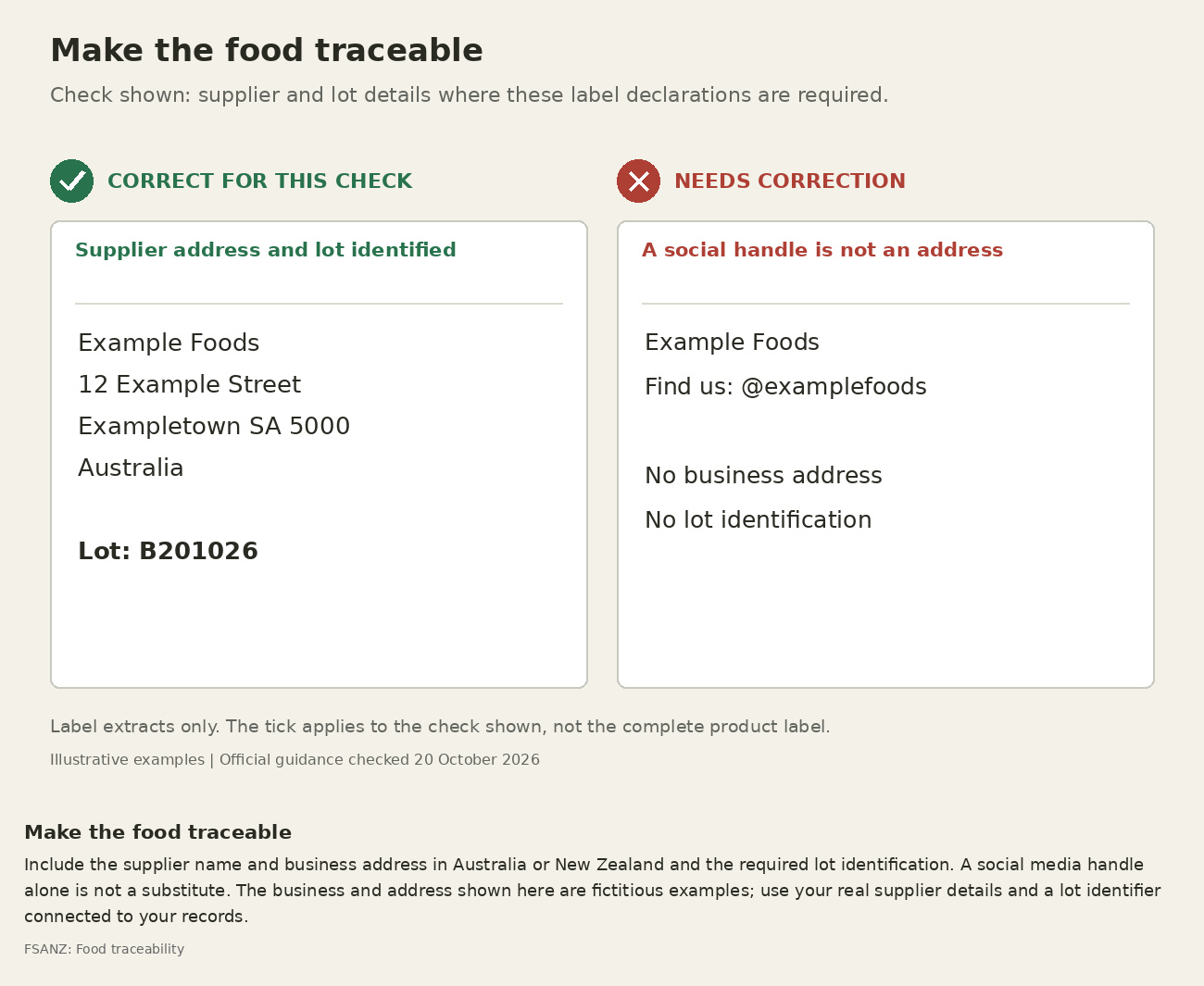
- Lot or batch identification.
- Supplier name and business address in Australia or New Zealand.
- Ingredients and required allergen declarations.
- Required date marking, storage instructions and directions for use.
- A nutrition information panel, where required.
- Percentages for characterising ingredients or components, where required.
- Any mandatory warning, advisory or product-specific statements.
- Country of origin information and quantity marking under the separate rules.
Requirements: Standard 1.2.1, section 1.2.1—8 and NSW Food Authority’s explanation of the national Code. Identification: FSANZ food traceability guidance.
3. Ingredients: work from the recipe
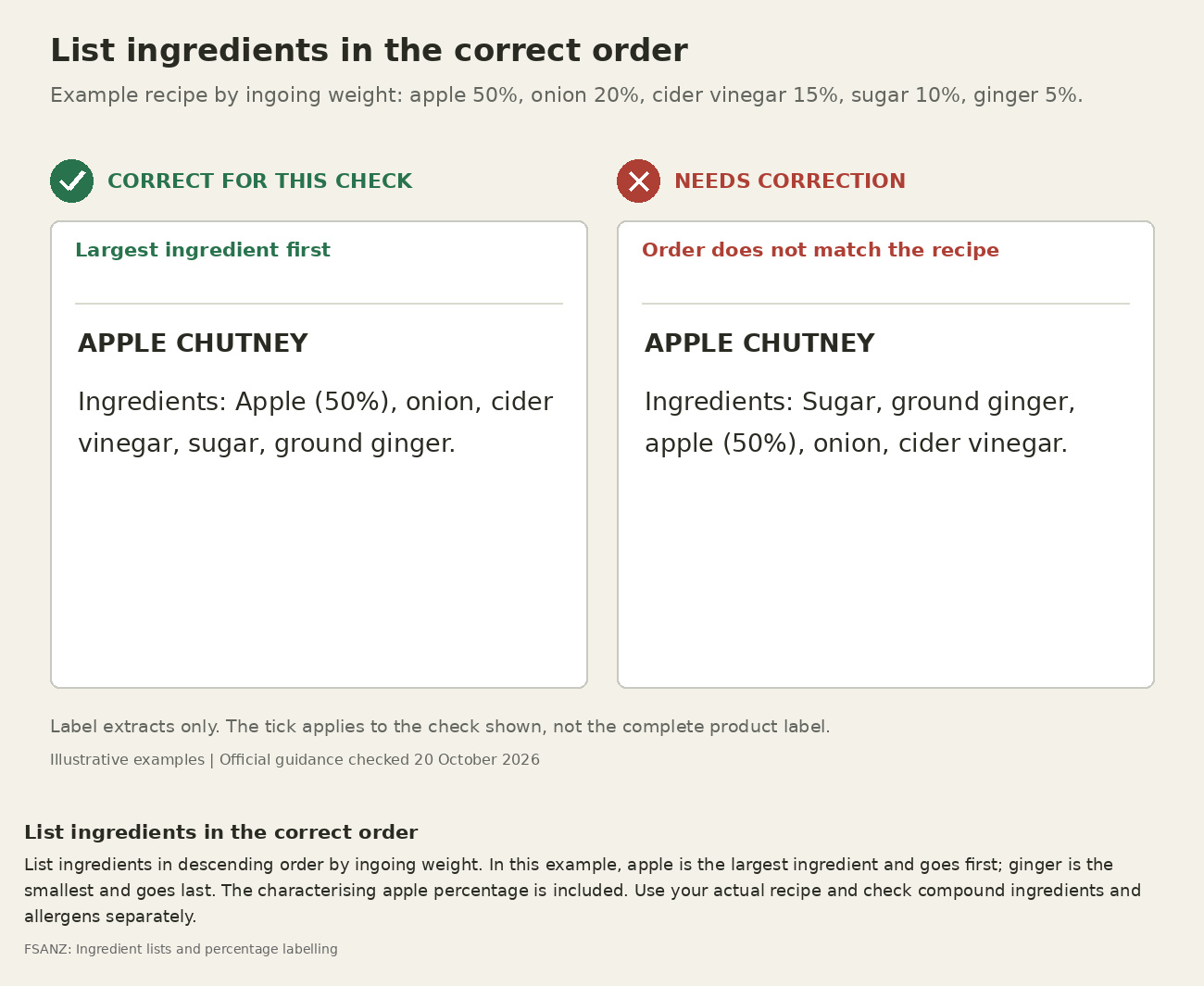
List ingredients in descending order of their ingoing weight. Check compound ingredients such as chocolate, pastry, stock and sauces. Their component ingredients may also need listing. An allergen in a compound ingredient still needs declaration even where an ingredient-listing exemption applies.
Most packaged foods also require percentages for their characterising ingredients or components. For example, a strawberry product may need the strawberry percentage. Calculate this from the actual formulation and the relevant rules.
FSANZ ingredient lists and percentage labelling.
4. Allergens: clear names and a clear declaration
Plain English Allergen Labelling requirements are now in force. The sell-through period for food labelled under the previous rules ended on 25 February 2026.
Required names include wheat, fish, crustacean, mollusc, egg, milk, lupin, peanut, soy (or soya or soybean), sesame, and individual nuts: almond, Brazil nut, cashew, hazelnut, macadamia, pecan, pistachio, pine nut and walnut. Barley, oats and rye require declaration when they contain gluten. Added sulphites require declaration at 10 mg/kg or more.
Required names: FSANZ allergen list.
Where an ingredient list is required, use the prescribed allergen names in bold, in type no smaller than the other ingredients. Add a separate bold Contains statement directly next to the ingredient list, in the same field of view. Wheat must be identified; gluten must also appear in the summary when present. Specific exemptions exist for some derivatives.
Contains wheat, gluten, milk, egg.
This could apply to a product containing ordinary wheat flour, milk and egg. It is not a complete label. The ingredient list must also identify the relevant allergens correctly.
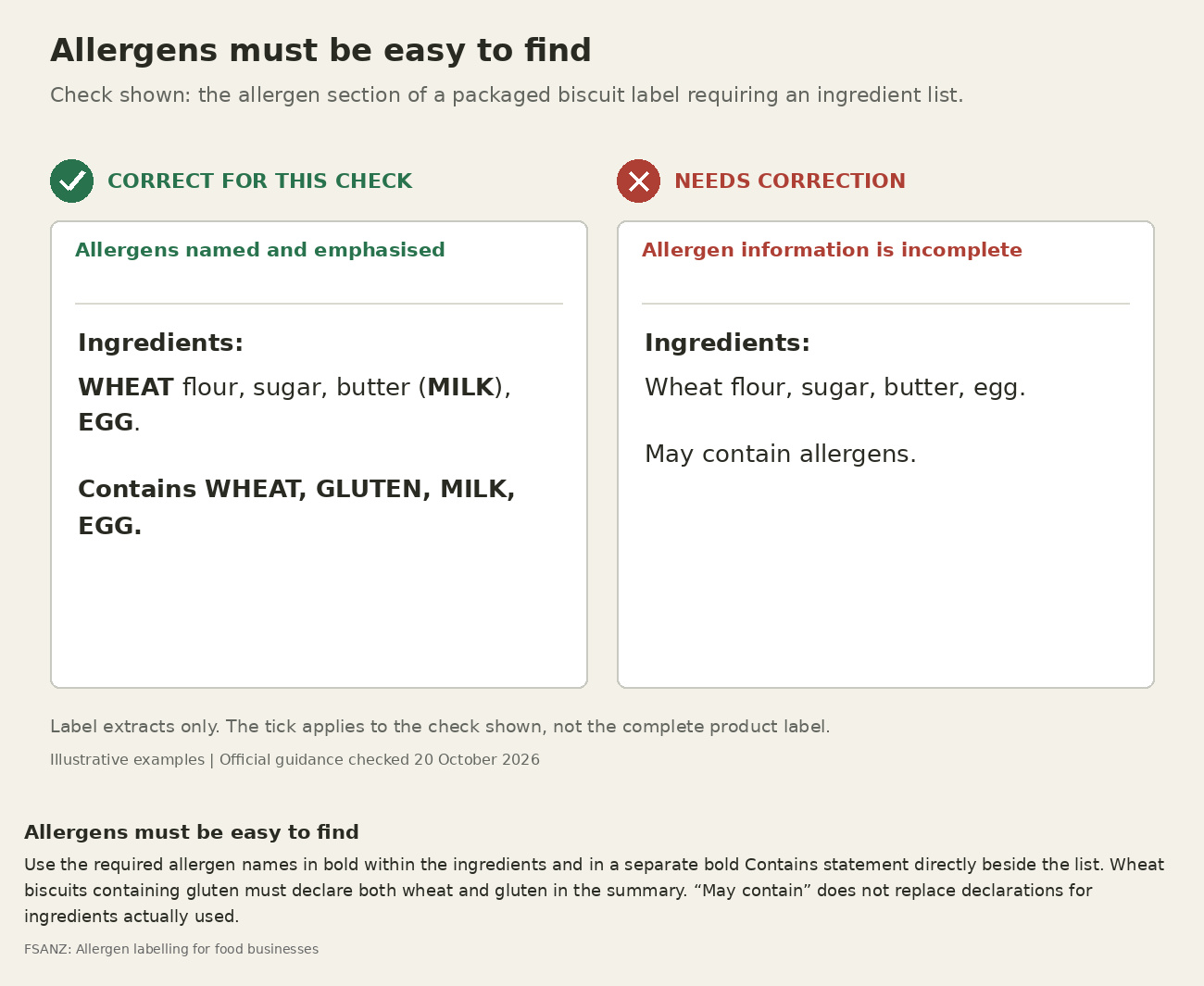
FSANZ allergen labelling for businesses, including the complete rules and exemptions.
Allergen information at the stall
For food that does not require a label, declarations must be displayed with the food or supplied to the purchaser on request, using the required names. A sign saying “Ask about allergens” is useful, but staff must be able to provide accurate information.
“May contain” statements describe possible unintended allergen presence. They are voluntary and do not replace declarations for ingredients deliberately used.
FSANZ allergen information and precautionary statements.
5. Dates and storage instructions
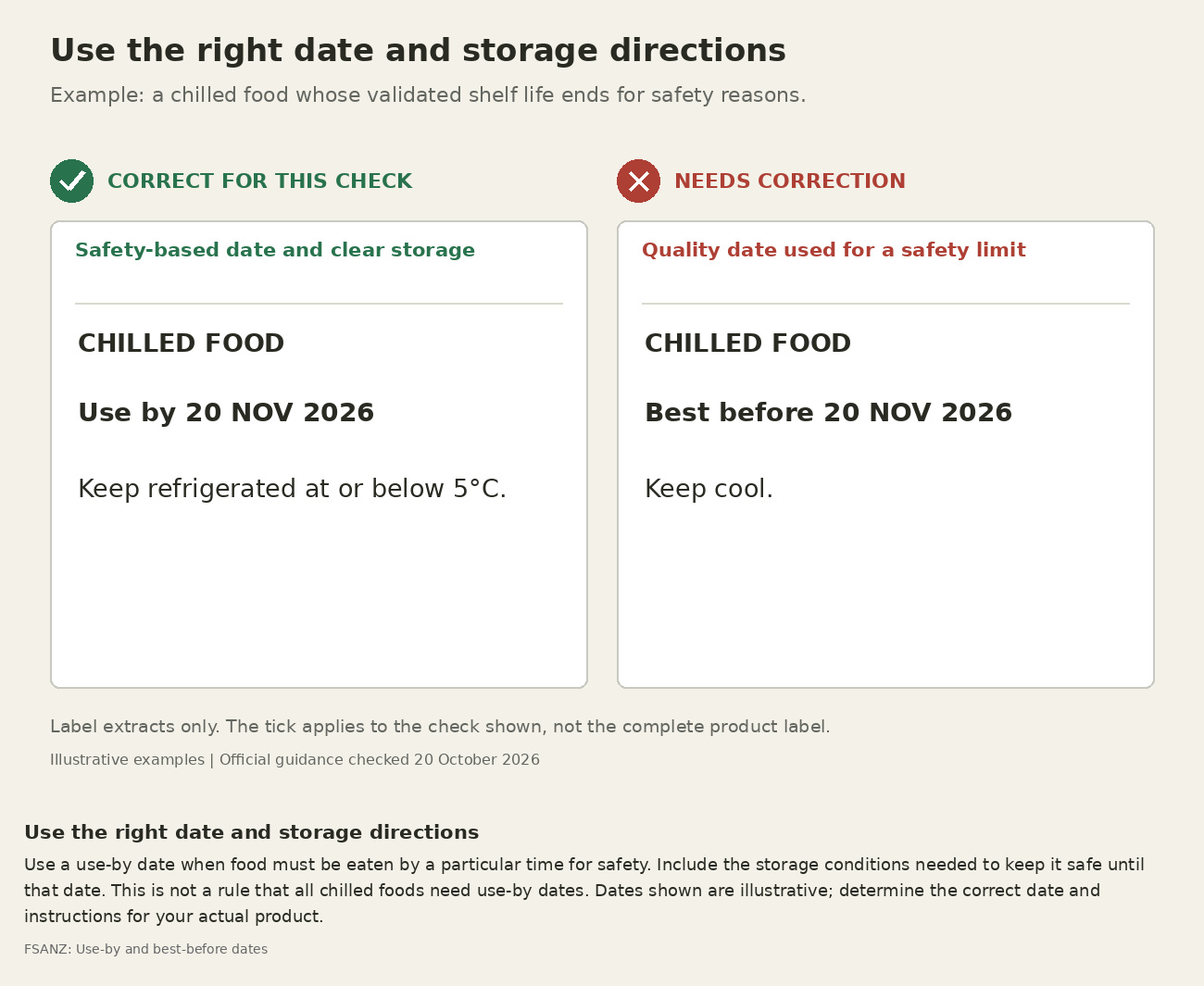
Use-by relates to safety. Food cannot legally be sold after its use-by date.
Best-before relates to quality. Food may legally be sold after that date if it remains fit for human consumption.
Include storage conditions needed for the food to keep until its marked date, such as refrigeration instructions. Bread with a shelf life of less than seven days has specific baked-on or baked-for options. Products with a shelf life of two years or more generally do not need a best-before date.
FSANZ use-by and best-before guidance.
6. Nutrition information panels
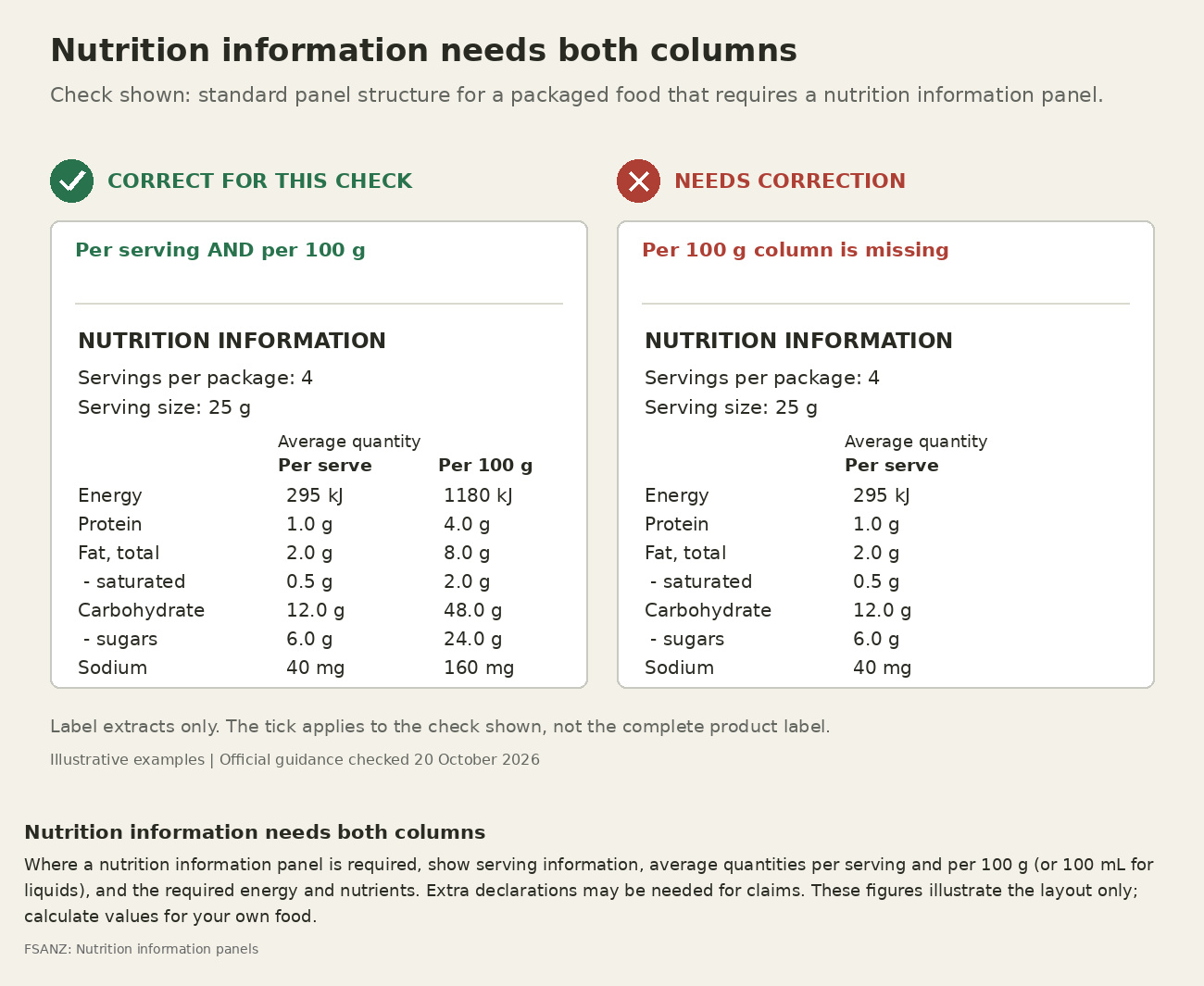
Where required, a nutrition information panel shows average energy, protein, total fat, saturated fat, carbohydrate, sugars and sodium per serving and per 100 g or 100 mL. The standard panel also identifies serving size and servings per package.
Some foods are exempt, including certain unpackaged foods, foods made and packaged at the point of sale, and products such as plain herbs, spices, tea and coffee. Claims such as “low fat” or “good source of calcium” can create additional nutrition information requirements.
FSANZ nutrition information panels.
7. Country of origin and product provenance
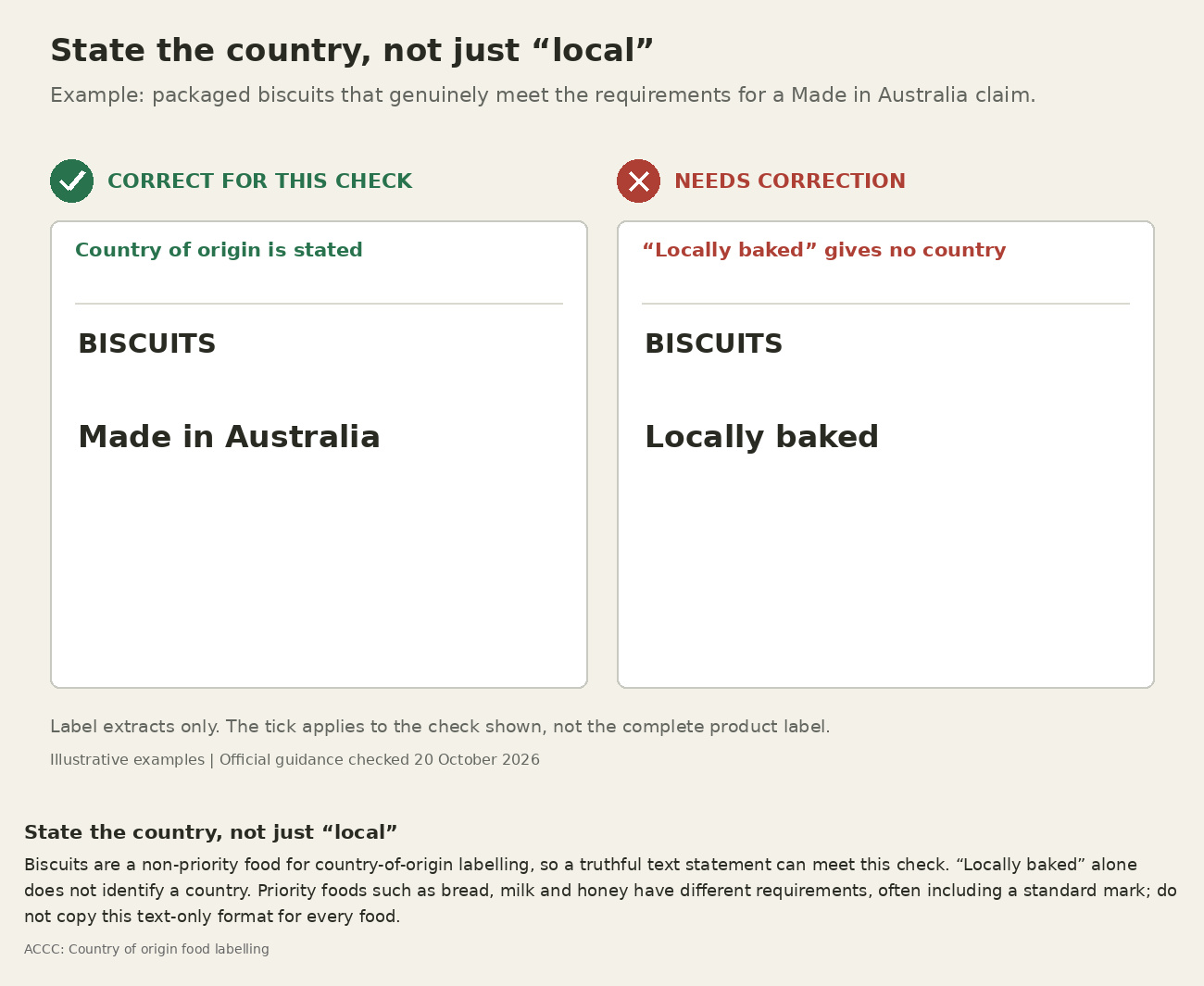
Customers need to know where their food comes from. Provide the country of origin information required for your product. These national requirements apply in South Australia, including at farmers’ markets.
Most packaged retail foods need country of origin information. Some unpackaged foods also need it, including fruit, vegetables, nuts, herbs, fish and most meat. A sign beside the product can provide the required information for unpackaged food.
The format depends on the product category and whether it was grown, produced, made or packed in Australia. Many Australian priority foods require the standard kangaroo logo, bar chart and explanatory statement. Non-priority foods, such as biscuits, tea and coffee, generally require a text statement.
“Made in Australia” does not necessarily mean all ingredients are Australian. Keep evidence supporting the origin statement and review it when ingredient sourcing changes.
ACCC country of origin guidance. Use the free government country of origin label tool to work through your product’s requirements.
Add your farm and regional provenance
Help customers understand who grew or made the product and where. Use accurate details such as the farm, town or region, and distinguish the place of manufacture from the origin of ingredients. For example, making a sauce in South Australia does not mean all its ingredients were grown here.
Regional provenance adds detail to the mandatory country of origin declaration. There is not a general national requirement for every food label to list every ingredient’s farm or South Australian region. Any provenance claim you choose to make must be truthful and supported by records.
Ready-to-eat seafood: rules from 1 July 2026
Market stalls serving seafood dishes for immediate consumption are covered by the hospitality seafood origin rules. Tell customers whether the seafood is Australian, imported or mixed before they order.
You can use A, I or M with a legend, or the permitted detailed wording. Check the rules for which dishes require a declaration and the options for a single origin statement.
Legend: A = Australian; I = imported; M = mixed.
Use “A” only when supported by the seafood’s actual origin.
Seafood labelling requirements and commencement on 1 July 2026.
8. Quantity and packer details
Check national trade measurement rules separately from food label exemptions. Pre-packaged goods generally require a quantity marking. Show the net quantity, excluding packaging, using the appropriate units, such as 250 g or 500 mL. Marking size and placement have specific requirements.
Goods packed in Australia generally need the packer’s name and Australian street address, or those of the person on whose behalf they were packed. A website, email address or PO box is not a substitute. Specific exemptions can apply.
National Measurement Institute guide to pre-packaged goods.
Bakery products have special rules for sale by weight or number, and some small individual items have exemptions. Check your exact product rather than assuming that all packs of cakes or biscuits can be sold simply by count.
NMI bread and bakery goods guidance.
9. Design for customers to read
Some products need additional statements. Bee pollen, propolis and royal jelly, for example, have specific advisory or warning requirements. Alcoholic beverages and other specialised products have additional rules. Check the relevant product standard as well as the general label checklist.
FSANZ warning and advisory statements and product standards in the Code.
Required information must be legible, prominent, distinct from its background and in English. Give it space. Check the printed label at actual size, including curved jars, chilled containers and any folds or seals that might hide text.
Use an accurate product name. Check claims such as “local”, “organic”, “gluten free” and “compostable” before using them. Claims must be truthful and supported; some have specific legal conditions. A QR code can add information, but should not replace information required on the label.
FSANZ truth in labelling and legibility and food labelling guidance.
10. Printing small runs in house
You do not need to order thousands of labels to present a small range well. Start with your weekly quantities, label size, colour requirements and storage conditions. Compare the cost per usable label, including ink or ribbon, blanks, waste, maintenance and your time.
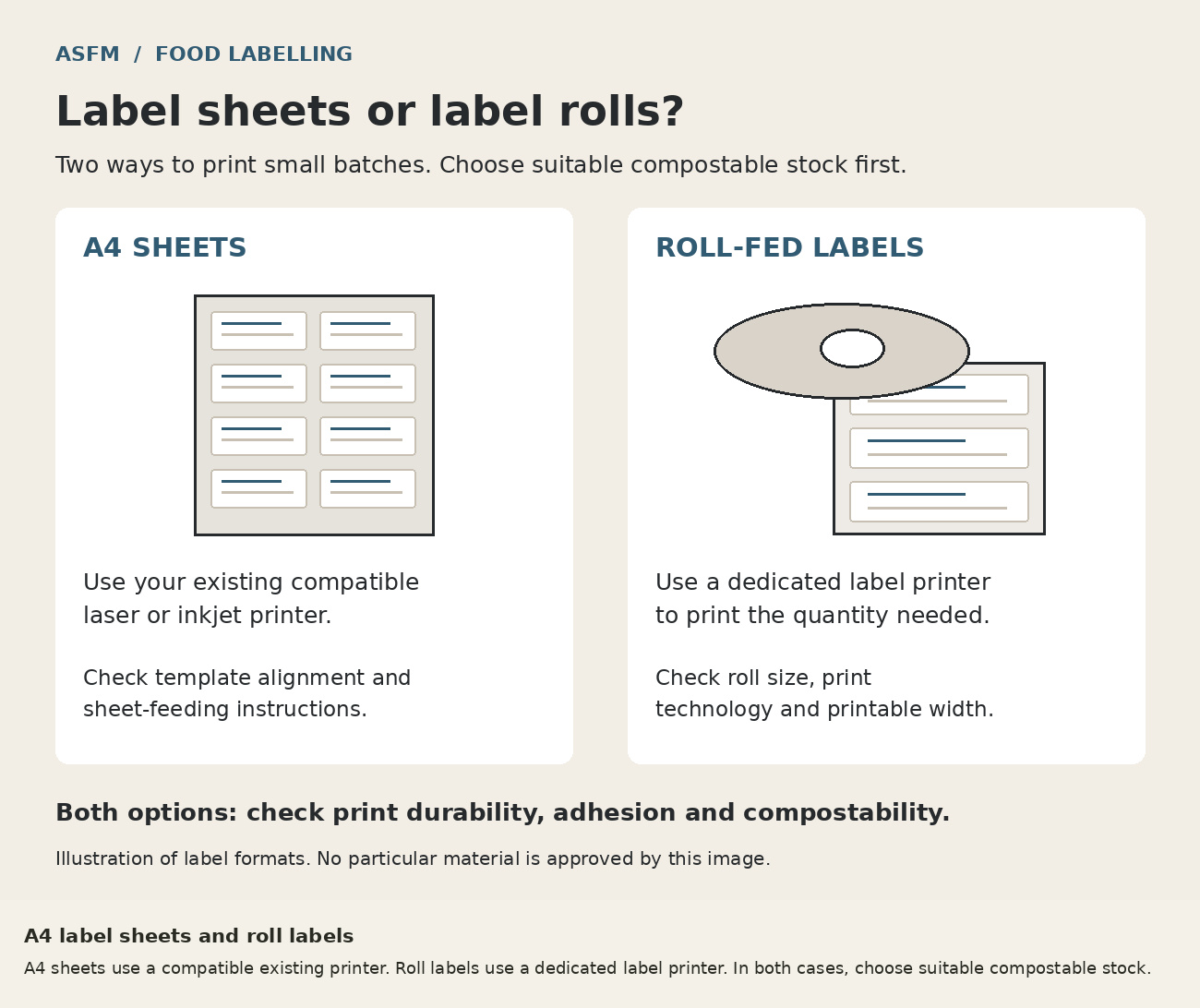
Option 1: A4 label sheets in your existing printer
For occasional small batches, pre-cut label sheets can be the most practical starting point. Use the supplier’s template and print with your existing laser or inkjet printer. You can produce colour branding and product information together, depending on your machine.
Buy sheets specifically compatible with your printer. A laser printer and an inkjet printer do not necessarily accept the same label stock. Use the correct media settings and print at actual size. Check alignment on plain paper first. Follow the printer and label supplier’s instructions about feeding and reusing partially used sheets.
For wet conditions, check the finished print’s resistance to smudging as well as the label’s resistance to water. “Waterproof label stock” does not guarantee that every ink printed on it will be waterproof.
Examples and material guidance: Avery Australia fridge and freezer label ranges and Avery guidance on waterproof materials and printer inks. These are durability references; check compostability separately before choosing a product.
Option 2: A desktop printer using rolls of labels
A roll-fed printer is useful when you repeatedly print small batches, change flavours or recipes, or add batch codes and dates. It can print the quantity needed without aligning a whole A4 sheet. Check the machine’s printable width against your complete label, including readable ingredients, allergens and any nutrition panel.
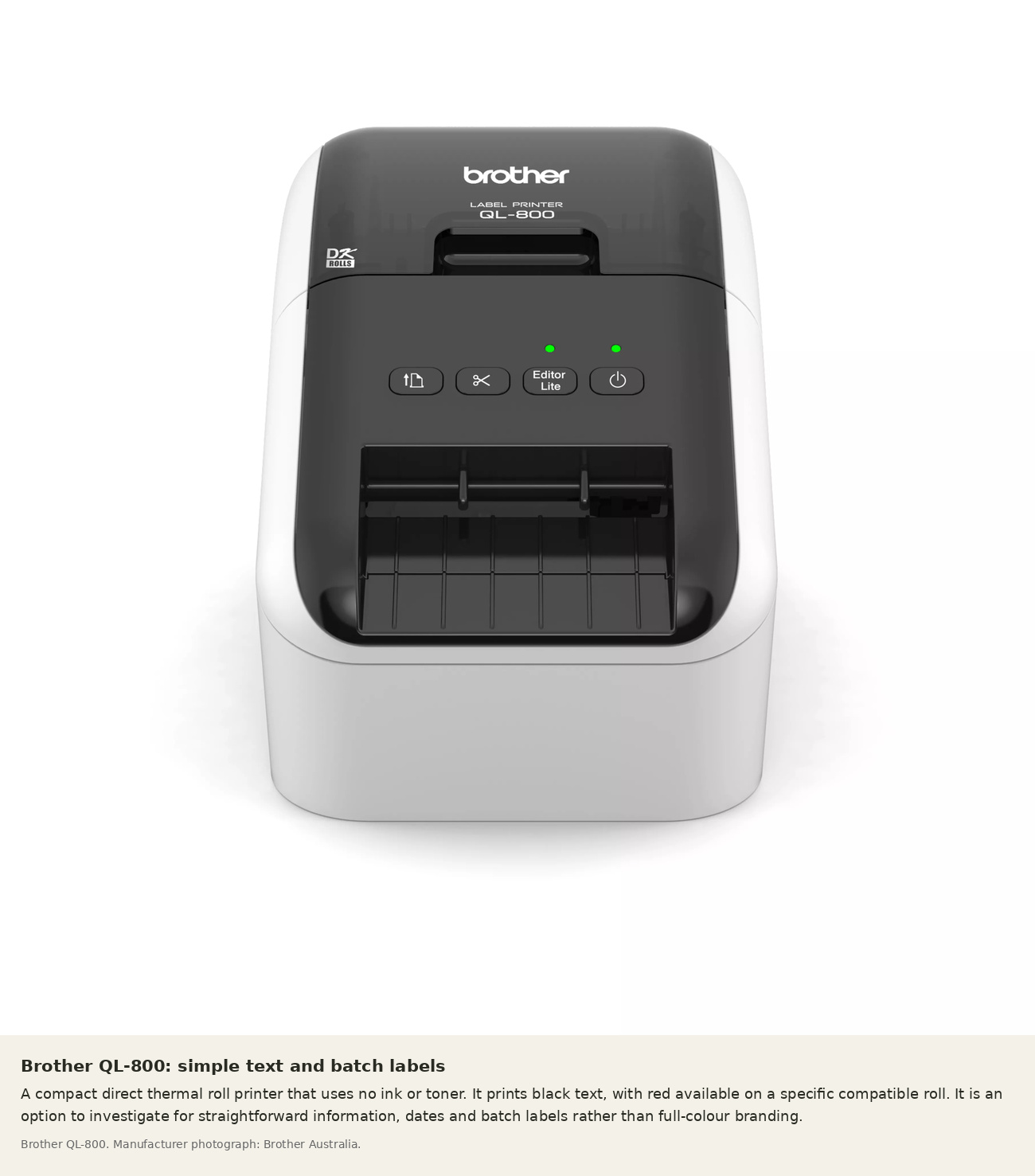
Brother QL-800: simple text and batch labels
A compact direct thermal roll printer that uses no ink or toner. It prints black text, with red available on a specific compatible roll. It is an option to investigate for straightforward information, dates and batch labels rather than full-colour branding.
Direct thermal printing uses heat-sensitive label material. Do not assume ordinary rolls are suitable for prolonged cold storage, moisture, sunlight or heat. Confirm the exact roll’s suitability and compostability before buying. A small label may not provide enough space for all mandatory information.
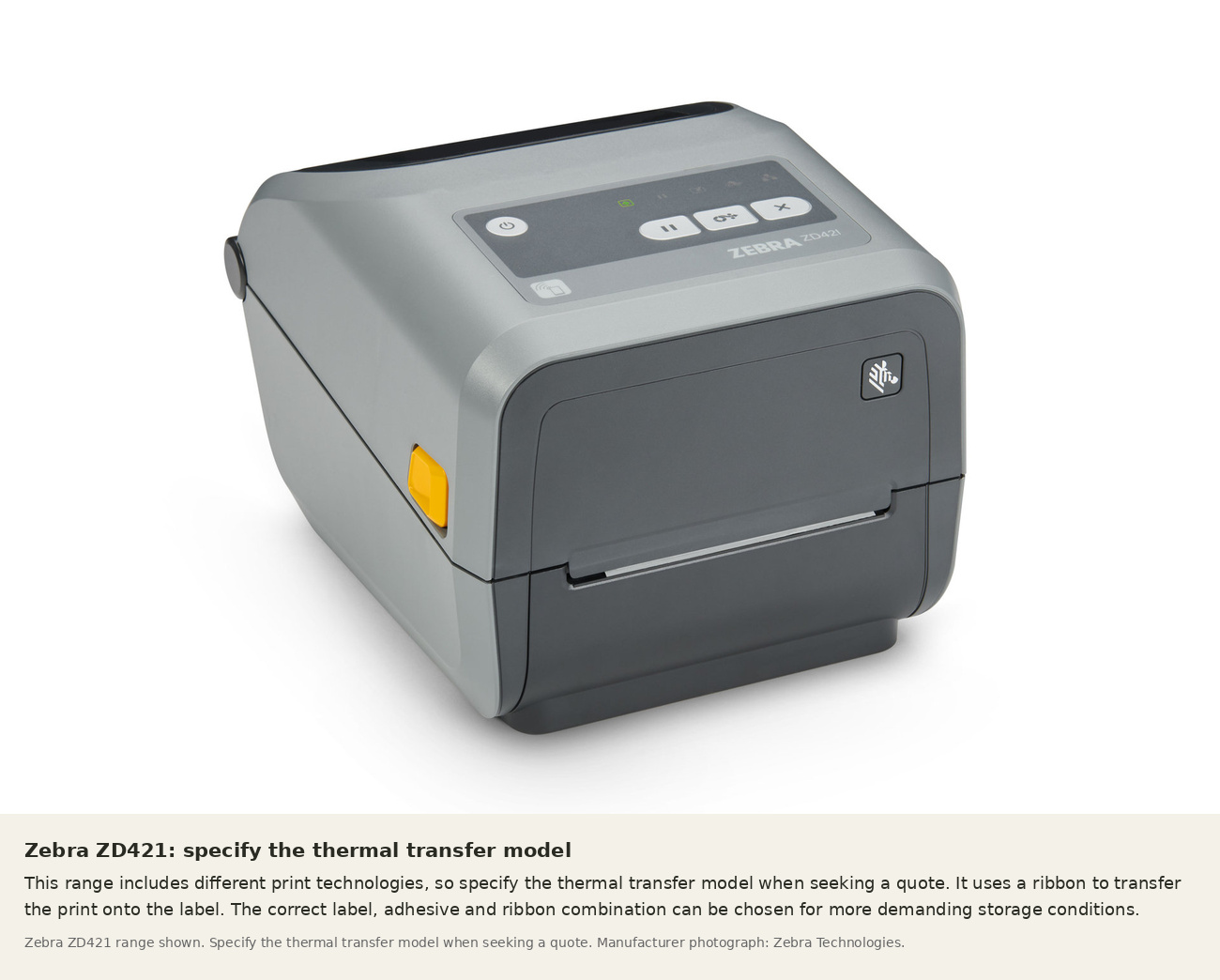
Zebra ZD421 thermal transfer model: investigate for durable information labels
This range includes different print technologies, so specify the thermal transfer model when seeking a quote. It uses a ribbon to transfer the print onto the label. The correct label, adhesive and ribbon combination can be chosen for more demanding storage conditions.
This is an option to investigate for regular product and batch labelling where durability matters. Ask a label specialist to demonstrate the finished print on suitable compostable stock. Standard synthetic freezer labels should not be assumed to meet the market’s packaging requirements.
Zebra ZD421 models and Zebra label selection guidance.
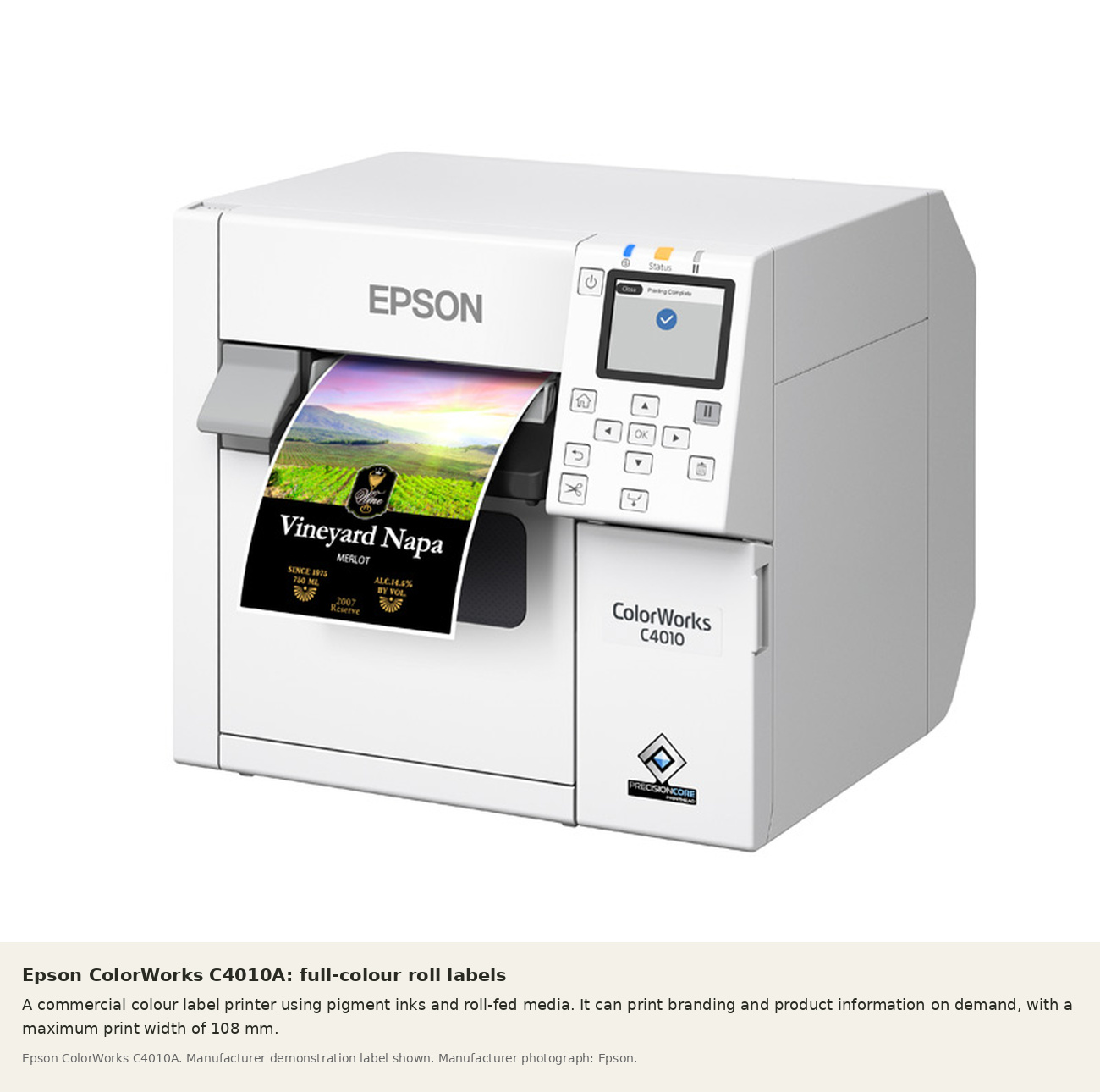
Epson ColorWorks C4010A: full-colour roll labels
A commercial colour label printer using pigment inks and roll-fed media. It can print branding and product information on demand, with a maximum print width of 108 mm.
Consider it when you have regular colour label production across several products. Compare a supplier’s complete running-cost quote with professional printing before investing. Obtain sample prints on the proposed compostable material and test them under your actual storage conditions.
Epson Australia ColorWorks C4010A specifications.
Option 3: Professional branding with variable details printed in house
A useful middle option is to have the main branded label professionally printed, then add dates and batch details in house. Another option is a professionally printed front label and an in-house information label on the back. Together, they must provide all required information in the correct format and positions.
If overprinting pre-printed rolls, check that the stock, coating, roll dimensions and ink are compatible with your printer. Keep the allergen summary directly next to the ingredient list where required. Both labels must meet the market’s compostability requirements.
11. Labels that last in the fridge or freezer
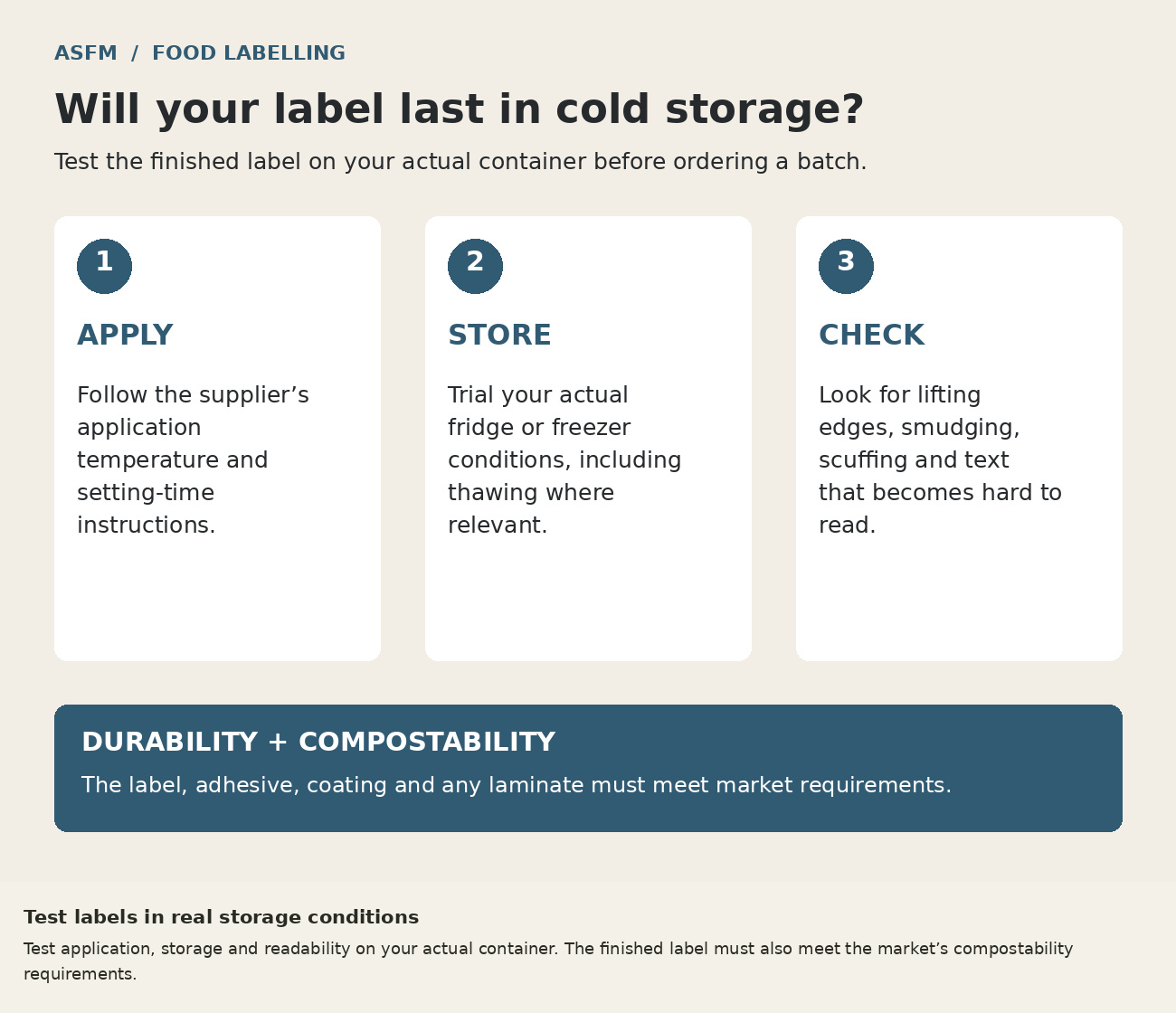
The label must stay attached and its information remain readable through the product’s expected storage and use. Cold, condensation, oil, handling and repeated freezing and thawing can affect different label systems differently.
- Application temperature: the temperature of the container when you attach the label.
- Service temperature: the temperatures the labelled product will experience afterwards.
- Container surface: glass, paperboard and flexible pouches may need different adhesives and materials.
- Print durability: check that the actual ink or ribbon remains readable when wet or rubbed.
A label rated for freezer storage may still need to be applied to a clean, dry container at a warmer temperature. If you label already chilled or frozen containers, ask specifically for that application. Follow the supplier’s instructions for application and adhesive setting time.
Zebra guidance on application and service temperatures.
12. Recommended local printing: Print Matters, Norwood
Adelaide Showground Farmers’ Market recommends Print Matters at Norwood for exceptional printing services at competitive prices. Their services include short-run labels. They are a useful option for stallholders who would prefer professional printing or want to compare it with buying their own equipment.
Ask for a quote based on your label dimensions, quantity and number of designs. Explain whether the products will be stored at room temperature, refrigerated or frozen, and that the finished labels must meet the market’s compostability requirements. Ask about suitable materials, proofs and sheet or roll supply.
Print Matters
182 Magill Road, Norwood SA 5067
Phone: 08 8331 8713
Email: sales@printmatters.com.au
Visit Print Matters
The quality and value recommendation is the market’s endorsement. Confirm current quotes, materials and availability directly with the printer.
13. Additional market requirements
These are Adelaide Showground Farmers’ Market requirements, separate from the statutory food labelling rules:
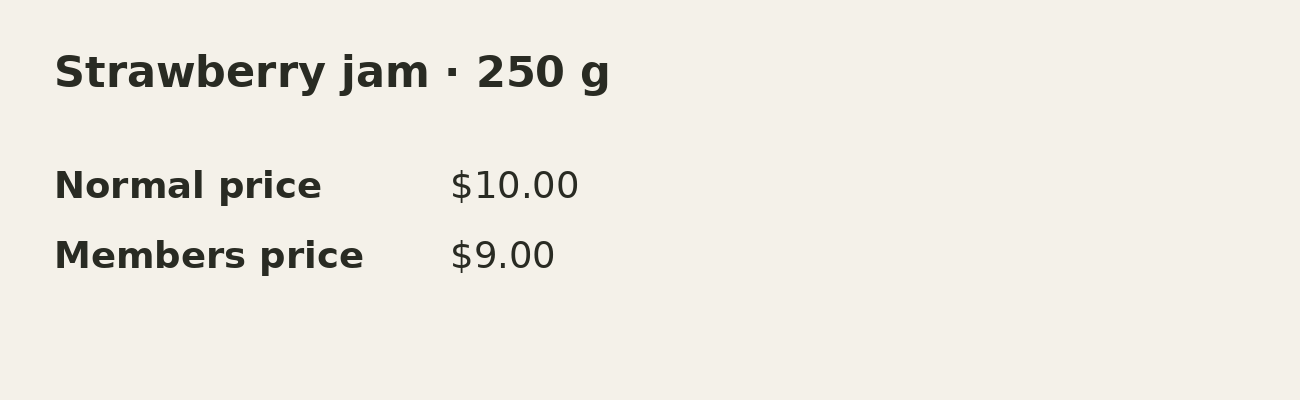
- Display the normal price, with the members’ price underneath.
- The members’ price is 10% less than the normal price: normal price × 0.90.
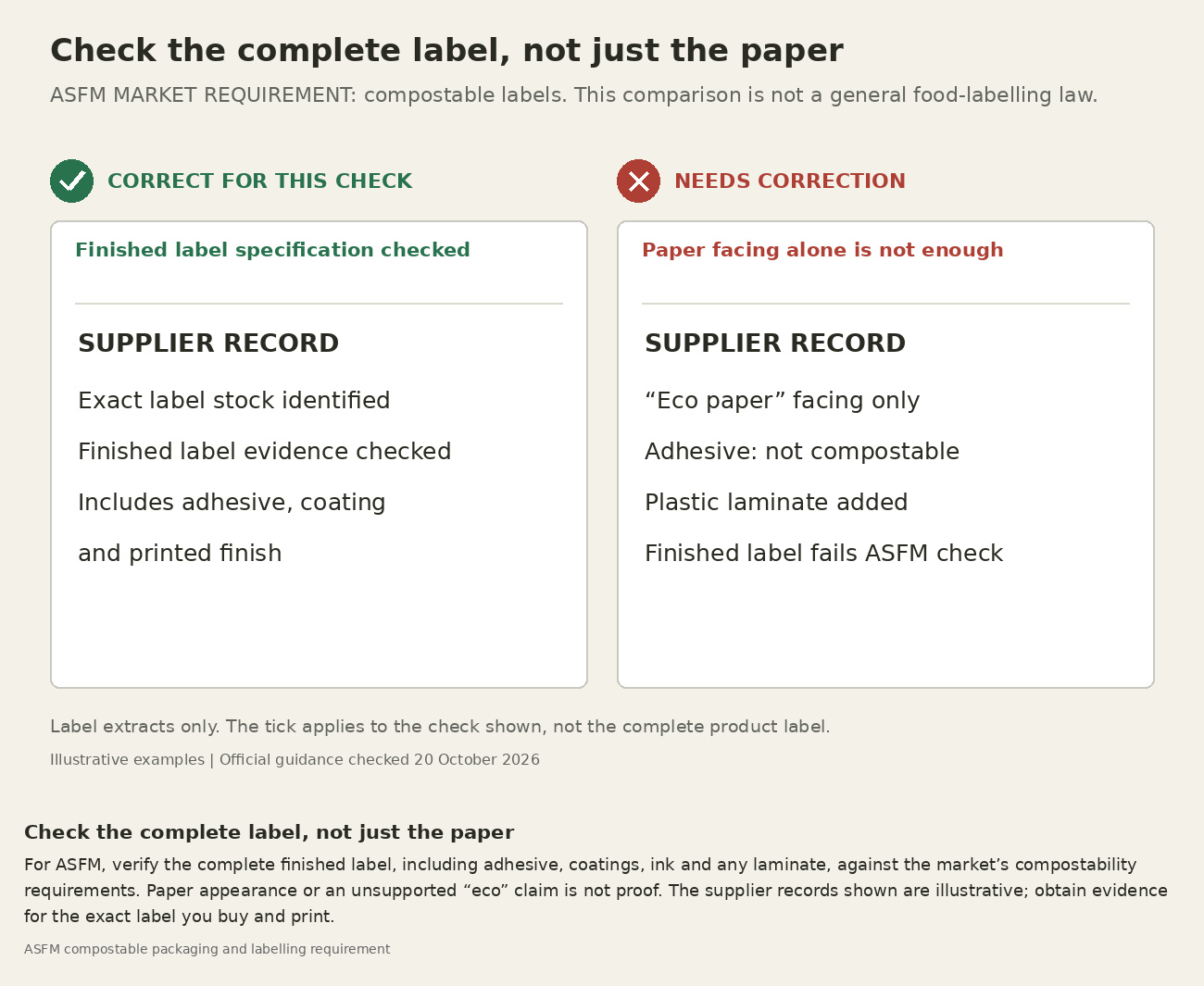
- Use packaging and labels that meet the market’s compostable packaging requirements. Check the finished label, including adhesive, coating, ink and any laminate. Paper appearance alone does not demonstrate compostability.
Labelling Examples
Before the next market
- Check the label requirements for each product and sales method.
- Review recipes, bought-in ingredients and allergen declarations.
- Confirm dates, storage instructions, nutrition and origin information where applicable.
- Check net quantity, supplier and packer details.
- Print a sample and check readability at actual size.
- Test the finished label on the actual container under its expected fridge, freezer or room-temperature conditions.
- Confirm that labels, as well as packaging, meet the market’s compostability requirements.
- Keep product information and allergen records available to all staff.
- Check normal and members’ prices and packaging against market requirements.
Where to get help
Ask your local council’s Environmental Health Officer about food label requirements and product-specific exemptions. Use FSANZ for the Code and labelling tools, the National Measurement Institute for quantity markings, and the ACCC or South Australian Consumer and Business Services for consumer law and origin claims.
Guidance updated on 11 October 2026. Printer examples are options to investigate, not approvals of their standard label materials. Review this page when requirements change. Stallholders remain responsible for their own products and labels.